Same story, different day
A six-part Instagram carousel about ordinary moments, built from my own photographs.
10 Sept 2026
If you came here from the carousel, this is the long version, the structure underneath it, and what I would change before making another one.
What I made
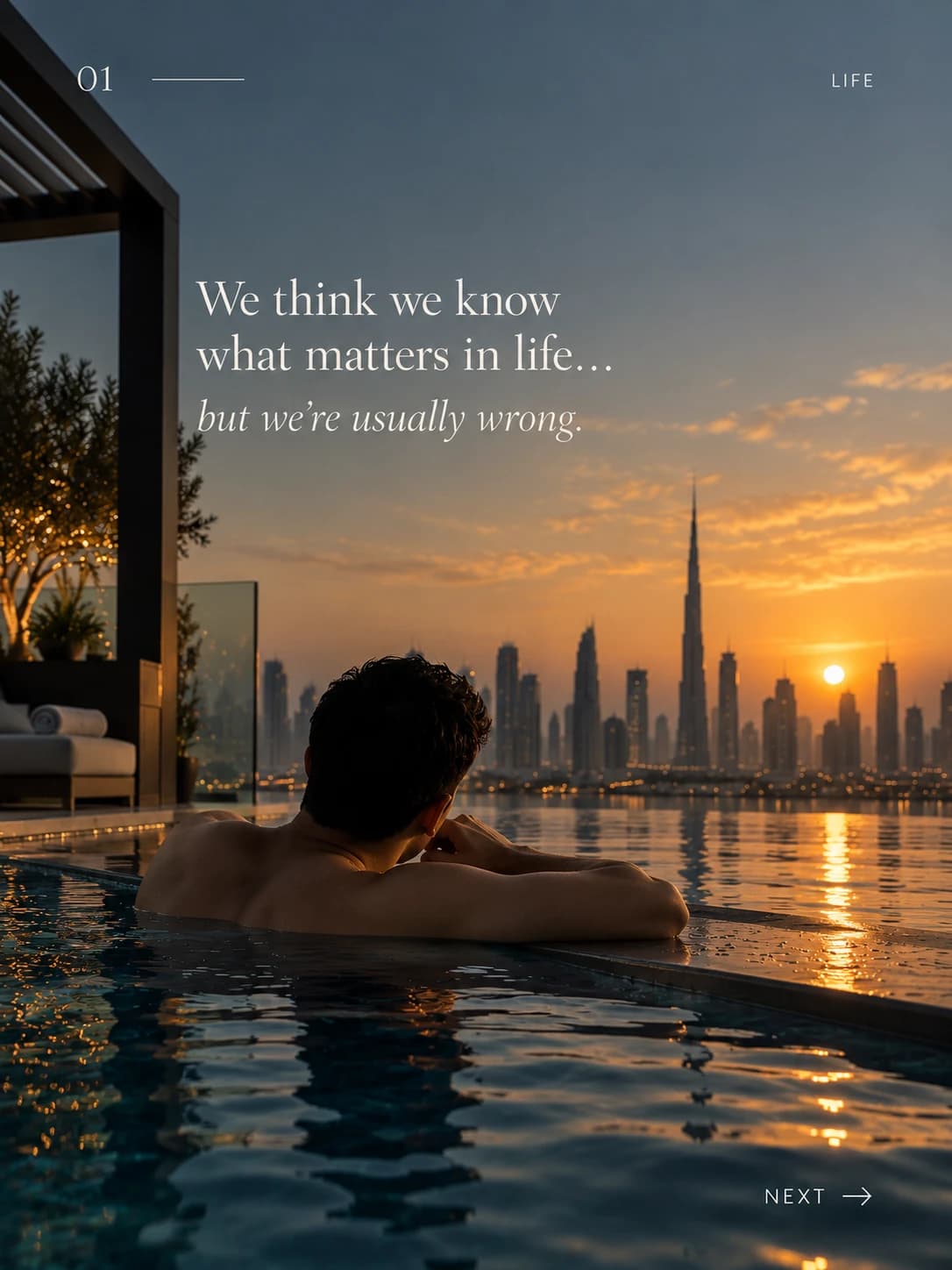
Six slides that argue their way to a single idea: that you only recognise the good part of your life after it has already moved. Each slide is numbered and labelled, so the reader always knows where they are in the argument.
| Slide | Label | The line |
|---|---|---|
| 01 | Life | We think we know what matters in life… but we're usually wrong. |
| 02 | People | We chase things we don't have, until we realize what we already had. |
| 03 | Time | We spend years trying to become someone, when sometimes we just need to become ourselves. |
| 04 | Knowledge | And the strange thing about time is… you only understand its value after it passes. |
| 05 | Perspective | Maybe that's why the little moments matter more than we think. |
| 06 | Reflection | Because one day, these ordinary moments will be the memories we wish we could return to. |
Two decisions did most of the work.
The moments are real; the finish is not. Every frame is a photograph I took, a gym mirror, a poolside afternoon, a stack of books under a desk lamp, a Starbucks cup beside a notebook. None of it was staged for the post. What AI did was relight, retouch and upscale them afterwards, so a phone snapshot could hold a full-bleed slide without falling apart.
That distinction is the piece. A carousel arguing that ordinary moments matter would be hollow if the moments were generated, the argument only survives if the afternoon actually happened. Enhancement is a darkroom. Generation would have been a lie.
The type never competes with the picture. One serif line in roman, one in italic underneath, always in the upper third, always on the calmest part of the frame. The number and the label sit in the top corners in small caps so the eye finds its place before it starts reading. I did not lay this out by hand, it was generated, then rejected and regenerated until all six frames agreed with each other.
Tools used
ChatGPT for two separate jobs: enhancing photographs I had already taken, relight, retouch, upscale, and drafting the six lines. Neither came out usable first time. Claude for the caption and hashtags once the slides existed. Instagram for the music.
The slide layouts were generated too, no design tool was opened at any point. The consistency across the six frames came from iterating on the same conversation until the type landed in the same place every time, not from a template I built and filled. That is the part I would do differently: a template makes slide seven cheap, and this approach makes it exactly as expensive as slide one.
The prompt
There wasn't one, and that turns out to be the useful part.
I did not arrive with a finished idea and write a prompt for it. I opened a conversation about wanting to post something on social media, brought what I already had, and the carousel format came out of the discussion itself. I had never made one before, this is the first carousel I have posted.
So the closest thing I have to a prompt worth passing on is a method rather than a paragraph:
Start from brainstorming. Bring your ideas and your raw materials to the model, and discuss what the thing should be, before you ask it to produce anything.
That sounds obvious written down. It is the opposite of what I actually did the first four times, which was ask for output and hope the idea would arrive with it. The conversation is where the decisions get made. Generation is only what happens after they are made, and a model cannot make them for you because it does not know which photographs are sitting on your phone.
Settings
Captions and hashtags: Claude, after the slides were finished. The music came from Instagram's own library, I picked it because it was genuinely relaxing to listen to rather than because it was trending, which I suspect matters more for a carousel people read slowly than for a reel they scroll past.
Step by step
-
The photographs came first. I had the pictures before I had a single line. That order did more for the piece than any other decision, the words had to earn their place against moments that already existed, instead of me going out to shoot an illustration of a sentence I liked.
-
The lines came out of ChatGPT, and then I rewrote them repeatedly. The first drafts read like captions: true enough, but the kind of thing anyone could have posted. Getting six lines that sounded like me, and that built on each other rather than restating the same thought six ways, took far more rounds of editing than writing them myself would have. The model was useful for finding the shape of the argument. It was not useful for the last ten percent, which is the part anyone remembers.
-
Four or five attempts failed before one worked. Plenty of photographs did not survive the enhancement, the frame was wrong, or the relit version stopped looking like the evening I remembered. I kept going until a set of six held together.
-
Captions and music last. The caption and hashtags were written once the slides were finished, and the track came from Instagram's own library. Both are the kind of decision that gets rushed at the end and shouldn't be, a carousel is read slowly, and the music sets the pace someone reads it at.
How to make it better
Have a plan before generating anything.
That is the whole lesson, and I learned it the expensive way. I started producing before I had decided what the piece was, what it should look like, what it was arguing, and crucially which assets I already had. So I generated, looked, disliked it, and generated again, four or five times over. Every one of those rounds was a decision I could have made in ten minutes at the start with a notebook.
Next time the order reverses: brainstorm the idea, settle the visual direction, take stock of the photographs I actually own, and only then open a model. AI shortens execution. It does not shorten deciding what to make, and treating it as though it does is how you end up with four failed carousels and a folder of pictures that nearly work.
A warrior between battles
A cinematic AI portrait of a warrior pausing mid-battle, built for an Instagram reel.
Read ProjectsThe prompt system I use to build client websites
Two documents instead of one prompt. A permanent quality standard, and a per-client brief.
Read ProjectsBeki Uzbek Cuisine
A storytelling site for an Uzbek restaurant, built around the shared table rather than a menu grid.
ReadEvery project has its own page, written the same way as this one.